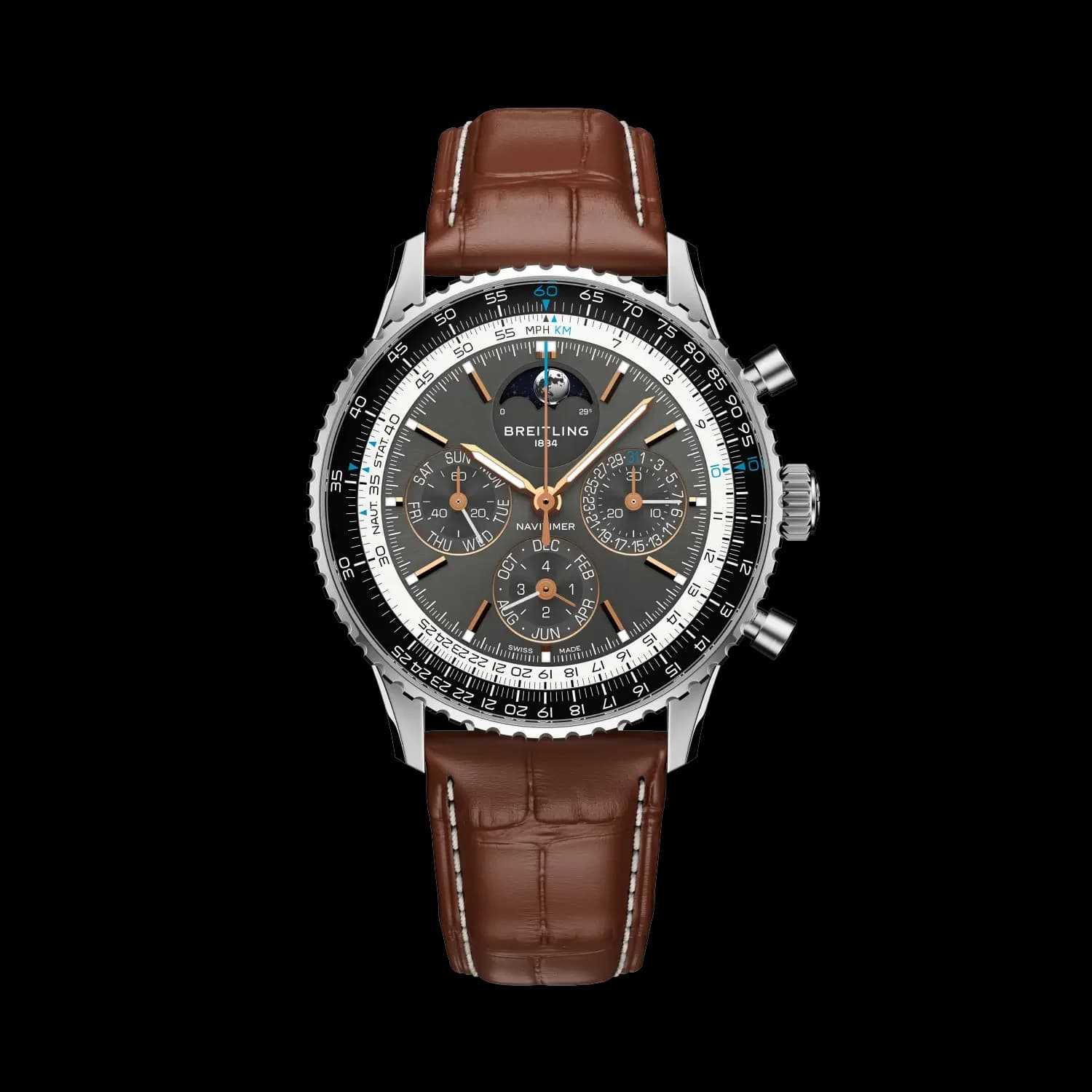
Slide rule is a watch complication: a rotating bezel with a logarithmic scale that turns against a second, fixed one. Lining the two scales up lets the wearer multiply and divide. It is most often seen on pilots’ watches, where it helps with quick calculations, but it also works as a general-purpose calculator.
How does a slide rule bezel work?
A slide rule watch carries two logarithmic scales, one inside the other. Only the outer scale rotates. The inner one stays put. The method rests on logarithms. Add the log values of two numbers and you get their product. Subtract them and you get the quotient. On a logarithmic scale, distance along the scale stands for the log value. So turning the outer ring against the inner one adds or subtracts those distances for you. Set one number against another, and the result can be read from the scales.
Where it comes from
The slide rule itself dates from about 1620 to 1630, soon after John Napier published the idea of the logarithm. The earliest patent for a watch with a built-in slide rule was filed by Emile Alexandre Moret of France. His French patent, titled “Montre à calcul”, was published in January 1905. Zenith filed a design in 1918 that appears to show a watch with a slide rule bezel. Even so, putting a circular slide rule on a rotating bezel was still a new idea in 1940. The slide rule bezel came before the more familiar count-up or count-down timing bezel.
Which watches have a slide rule?
In 1952 Breitling brought out a pilot’s wristwatch with a circular slide rule built in for flight calculations. Heuer registered the name Calculator, or Calculateur, in 1949. Its first slide rule watch only appeared in 1952. Breitling watches have the feature, and some watches made for aviation still carry slide rule scales so pilots can do quick calculations. Away from flying, the same bezel serves as a general-purpose calculator for anyone who needs to multiply or divide.
Not to be confused with
A slide rule scale is not the same as a tachymeter. A tachymeter uses a hyperbolic scale, which usually counts down from infinity to sixty. A slide rule uses logarithmic scales instead. There are two of them, and only the outer one rotates against the inner. Lining those scales up lets the wearer do arithmetic, mainly multiplying and dividing.
Checked