Konstantin Chaykin SC02C brings spacewalk lessons to a limited chronograph
Konstantin Chaykin’s hand-wound chronograph, refined through four spacewalks, arrives as a limited edition of 28 pieces.
3 min read
The SC02C from Konstantin Chaykin is a hand-wound chronograph shaped by real work outside the space station. It grew out of a research programme with Roscosmos that began in 2018, and Chaykin watches have now been worn on four spacewalks. It was shown earlier this year during Geneva Watch Days.
The prototypes flew first. Oleg Novitsky wore experimental versions on 2 June 2021 and 9 September 2021, and Oleg Artemyev did the same on 17 August 2022. In May 2026, cosmonauts Sergey Kud-Sverchkov and Sergey Mikaev strapped the newer generation of Chaykin chronographs on top of their Orlan-MKS suits and worked outside for more than six hours.
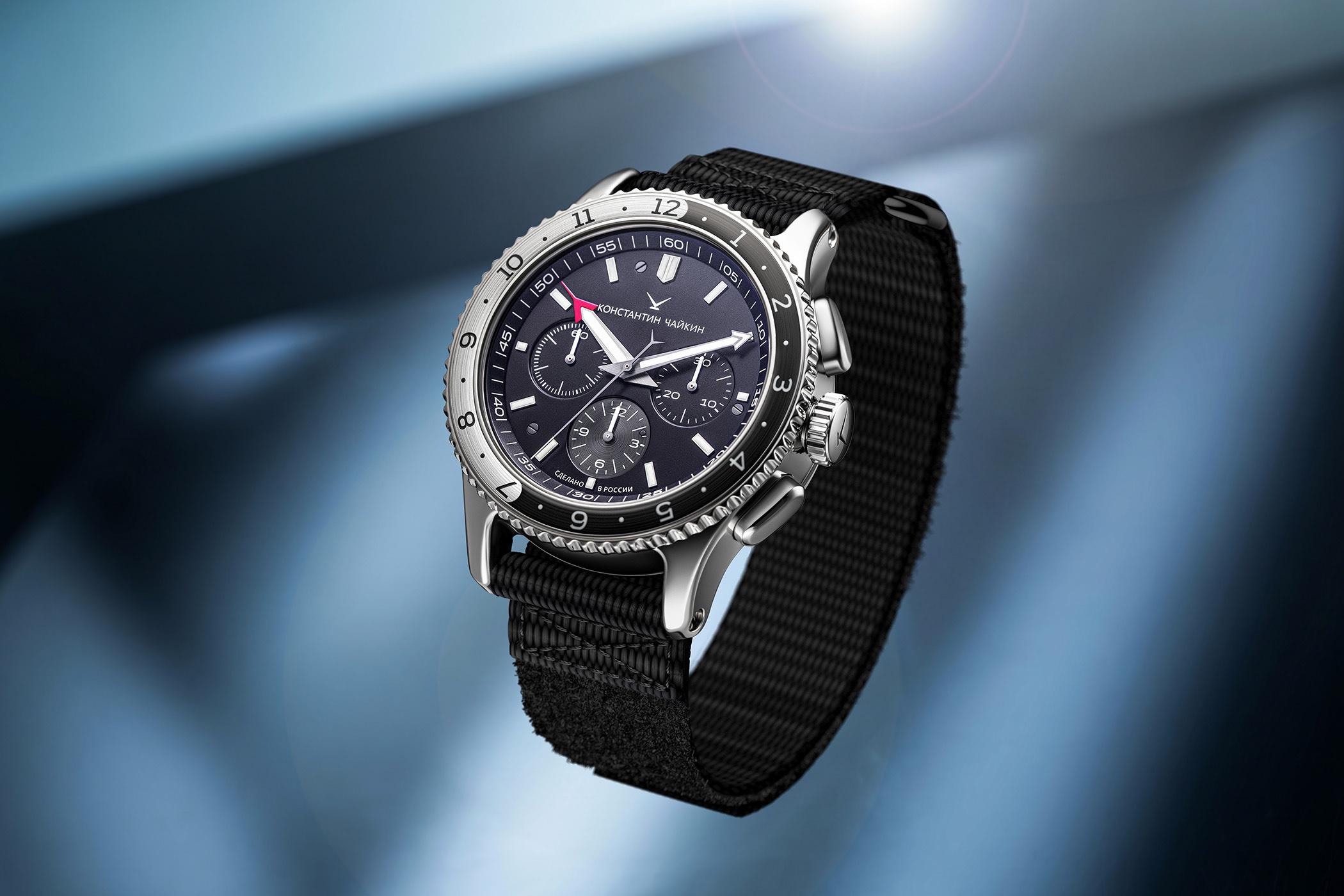
The production watch is a limited edition of 28 pieces. The steel case measures 44 mm across and 14.5 mm thick, half a millimetre smaller than the spacewalk watches, with rounded surfaces. It is water resistant to 10 ATM and specified for high vacuum, down to one-millionth of normal atmospheric pressure. A flat sapphire crystal sits in a reverse dovetail mounting, and there is an anti-magnetic cover. The strap pins are secured against working loose. Two straps are supplied: one for daily wear and one long enough to close over the thick cuff of a space suit.
The dial is black and clearer than before, with large markers, three registers and a red-tipped hour hand. The date, second time zone and four-day counter from the original Space Conqueror brief have been dropped. The chronograph counts up to 12 hours, and a rotating 12-hour bezel offers a separate way of timing something, independent of the chronograph.
Inside is the hand-wound calibre K.20-5, based on the Poljot 3133, with 60 parts made in the Chaykin manufacture for the modified movement. It has stop-seconds, a balance adjusted with micrometric weights rather than an index regulator, and a damping ring. Power reserve is 45 hours. Finishing has been improved over the flight watches. Before a spacewalk, the watch is wound fully by hand until the crown meets a firm stop.
Every production watch will go through a full laboratory programme: centrifuge, vibration, impact, thermal cycling, solar simulator exposure, plus sealing and vacuum checks.