Reverso: the watch that turns over
A polo field in India, a case that slides and flips, and the long, winding road of a rectangular watch that kept coming back.
4 min read
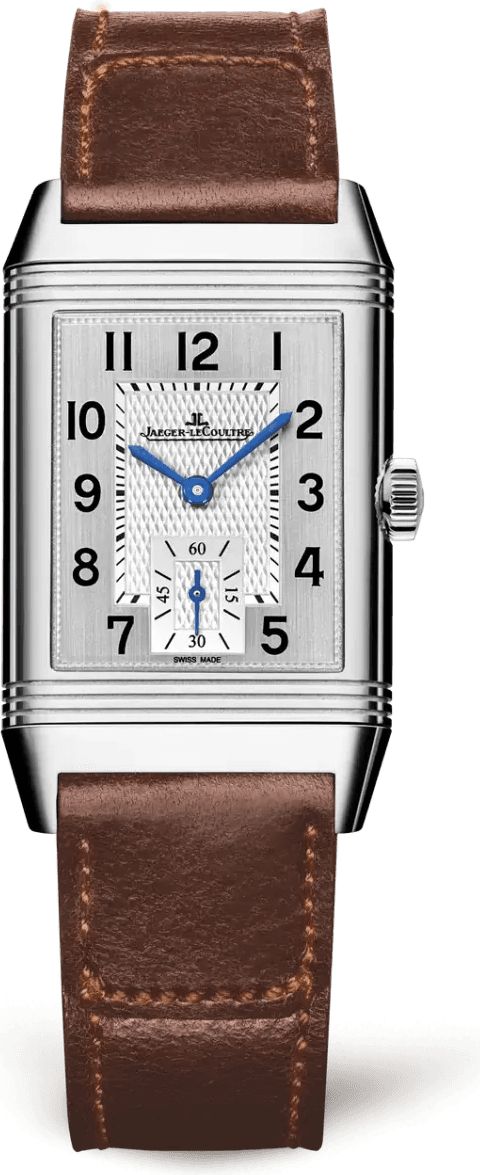
A problem on the polo field
The story starts on a polo field in India in 1930. Players there wanted a watch that could take the knocks of the game, because a crystal facing outward does not last long when mallets and horses are involved. César de Trey, a watch dealer, was the man they put the problem to.
He brought it to Jaeger-LeCoultre, where René-Alfred Chauvot, a French engineer working with LeCoultre, designed a case that could slide and turn over, hiding the glass behind a solid metal back. The name came from Latin, meaning ‘I turn around’. It is hard to think of a plainer description of what the watch does.
From patent to shop window in months
Things moved quickly. Chauvot’s patent application for a watch that could be slid and turned over, patent N°712.868, was received in Paris on March 4, 1931. In July of that year de Trey bought the rights to the design, and in November he registered the Reverso name.
The first watches were on sale less than nine months after the patent was filed. Spécialités Horlogères was founded in the autumn of 1931 to sell Jaeger-LeCoultre products, the Reverso among them. For a design that began as a sketch of an idea, it reached wrists remarkably fast.
How the case works
The first Reverso was built around a capsule that held the movement. That capsule sat in a cradle with grooves and locking pins, which is what lets the case glide sideways and flip. The original measured 38 mm long, 24 mm wide and 6 mm high.
The casemaker Wenger refined the shape into the streamlined rectangle people recognise today, and the result is often held up as a classic of Art Deco. In 1933 came Calibre 410, Jaeger-LeCoultre’s own rectangular movement, made to suit the case rather than squeezed into it.
A canvas on the back
The Reverso became a watch people wanted to personalise, and the blank steel back made that easy. Amelia Earhart and King Edward VIII both owned personalised examples. In 1931 the Polo Club Traveling Collection exhibition even took the Reverso as its central theme.
The back of the case has stayed a canvas ever since. Today it can carry engraving, enamel or a second dial, with Duoface and Duetto options for the reverse side. More recently, four Venetian paintings by JMW Turner decorate the backs of new white-gold Reversos, limited to ten pieces each.
The pause and the comeback
Jaeger-LeCoultre stopped making the rectangular Reverso in 1948, as the style fell out of fashion. That could have been the end of it. In 1972, Giorgio Corvo, the company’s agent for Italy, asked for the watch to return.
Three years later, in 1975, he acquired unused Reverso cases and had them fitted with movements. The Corvo Reverso retrofitted 200 old stock cases to hold the oval calibre 840. His push in Italy helped revive the watch, and in 1982 Jaeger-LeCoultre officially reintroduced the Reverso, mostly with quartz movements.
Bigger cases, bigger ideas
The 1990s brought a bigger case and more ambition. The Grande Taille Reverso of 1991 measures 42.2mm by 26.1mm. The same year, the Reverso Soixantième introduced complications to the line.
The ideas kept growing. The Reverso grande complication à triptyque, released in 2006, has three dials on one movement. At Watches and Wonders in 2021 the Hybris Mechanica Calibre 185 Quadriptyque showed four faces and eleven complications, a long way from a simple watch built to survive a polo match.
The house behind the case
The house behind the Reverso has its own long record of small, clever things. Antoine LeCoultre founded it in 1833 and invented the Millionomètre in 1844, a tool that measures the micron. The Calibre 101 of 1929 is still the smallest mechanical movement, and Elizabeth II wore a Calibre 101 wristwatch for her coronation in 1953.
The Atmos clock, invented by Jean-Léon Reutter in 1928, runs on tiny changes in temperature and atmospheric pressure. Since 1950 it has been the Swiss government’s official gift for important guests. Since 2011 the company has also worked with the polo boot-maker Casa Fagliano, a nod back to where the Reverso began.