The history of the Rolex Daytona, from 1963 to today
A racing chronograph that sold slowly at first has changed across four series, from hand-wound beginnings to in-house movements.
4 min read
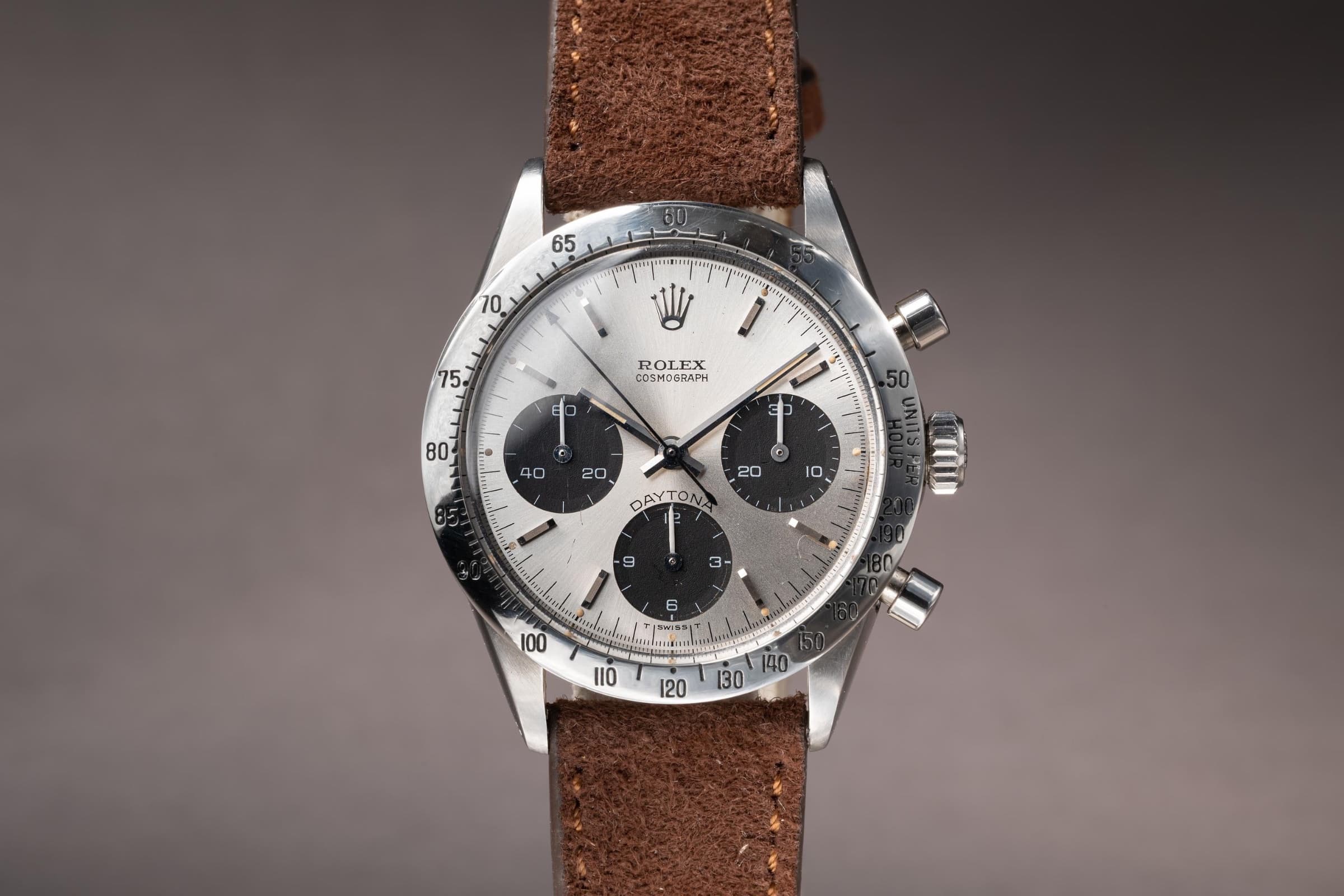
Before the name
Rolex was making chronographs long before anyone asked for a Daytona. The Pre-Daytona ref. 4500 dates to the mid-1940s, and early Rolex chronographs were popular with motorsport figures including Enzo Ferrari. Reference 6234 followed in 1955, with about 500 made each year until 1961.
Collectors also give the name Pre-Daytona to Reference 6238. Reference 6239 arrived in 1963, yet 6238 stayed in production until 1967.
The name itself points to Daytona, Florida, where racing flourished in the early twentieth century. Rolex has partnered with Daytona International Speedway since it opened in 1959, and in 1962 the brand became its official timekeeper. A year later the watch that carried the town’s name appeared.
A slow start in 1963
Reference 6239, introduced in 1963, was the first Rolex chronograph to be nicknamed Daytona. Its bezel was engraved with a tachymeter, there for racing drivers. The pushers were plain, and the case had none of the Oyster water-resistance features.
Inside sat the Valjoux Calibre 72, which Rolex reworked as Calibre 722. The original watch was hand-wound.
It did not sell well. The first Daytona was a slow seller, often heavily discounted by retailers. Today a 1963 Mark 1 Daytona is valued at $50,000 to $80,000.
Oyster cases and screw-down pushers
Reference 6240 brought Oyster features in 1965, including screw-down chronograph pushers. Plain pushers were kept until 1972.
From 1970, References 6263 and 6265 offered Oyster versions powered by Calibre 727. Many collectors consider the 6263 with its black acrylic bezel the ultimate vintage Daytona. In the early 1970s, References 6262 and 6264 moved the word Daytona above the 6 o’clock position on the dial.
All of these belong to the first series, the hand-wound era.
The Newman effect
Paul Newman’s Daytona was an original series watch with an exotic dial. Newman and Joanne Woodward starred in the 1969 film Winning, set partly in Daytona Beach.
In New York in 2017, the Paul Newman Daytona sold for about US$17.75 million.
Automatic power and in-house movements
The second series arrived in 1988 with Reference 16520, Rolex’s first automatic Daytona. Rolex used a modified Zenith El Primero movement and lowered its beat rate to 28,800 VPH, creating the Calibre 4030. The case grew from 37 mm to 40 mm, and the second generation used sapphire crystal.
Reference 16520 was offered in steel, steel and gold, and gold versions. Rolex has sponsored the 24 Hours of Daytona since 1991, tying the watch back to the track that gave it its name.
The third series followed in 2000 with Calibre 4130, Rolex’s first chronograph movement made entirely in-house, fitted with a Parachrom hairspring.
Ceramic, platinum and a fourth series
In 2013, Rolex marked fifty years of the Daytona with the Cosmograph Daytona Platinum, Reference 116506, nicknamed Platona, a platinum model with a ceramic bezel. Reference 116500 arrived in 2016 with a black ceramic bezel. The Monobloc Cerachrom bezel was introduced on the Cosmograph Daytona.
The fourth series appeared at Watches and Wonders in 2023. Reference 126500 LN is its stainless steel model, powered by Calibre 4131 with the Chronergy escapement and a 72-hour power reserve.
The Daytona also became the Official Watch of the 24 Hours of Le Mans. For the centenary edition, Calibre 4132 counts chronograph hours over 24 hours.
Why it stuck
Rolex has made the Cosmograph Daytona since 1963, across four series. The first was hand-wound, the second brought self-winding power, the third gave it a movement built entirely at Rolex, and the fourth added a longer reserve.
The watch began as a tool for drivers, with a tachymeter and a hand-wound caliber, and sold slowly. Along the way it gathered stories: a film set in Daytona Beach, an actor’s exotic-dialed watch, decades of sponsorship at the track.