What a perpetual calendar does, and how it counts the days
A perpetual calendar carries the rules of Pope Gregory’s reform inside the case, so the date moves correctly through short months and leap years.
4 min read
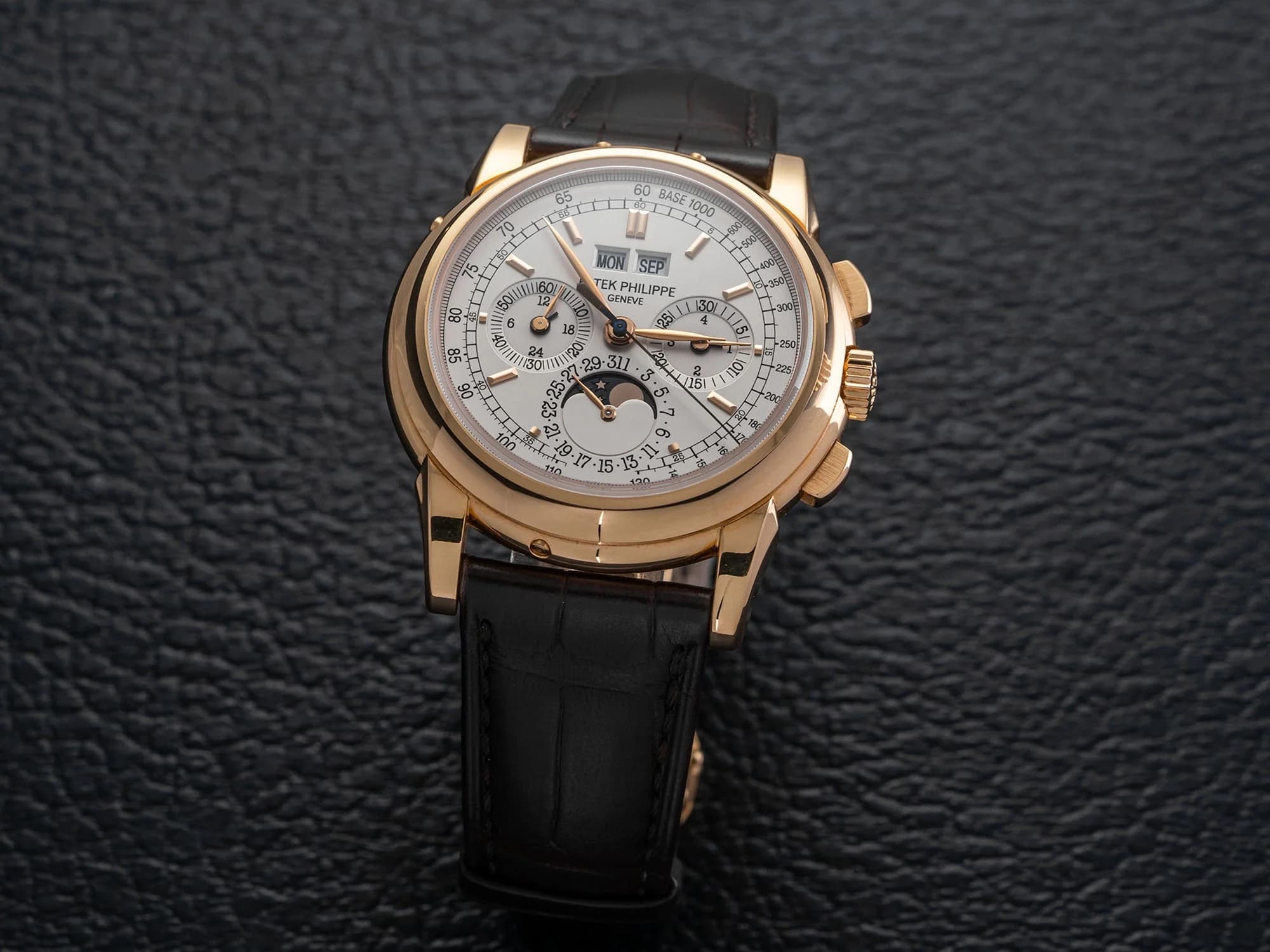
A watch that knows the month
A perpetual calendar watch moves the date to the next day, but it also has to know whether the month has 28, 29, 30 or 31 days. February gives it the most trouble. It has 28 days in a common year and 29 in a leap year, while the other months run to 30 or 31.
On paper, the job is a matter of rules. In metal, those rules become cams, levers and wheels. That is why these watches sit in the world of haute horlogerie and call for hundreds of extra gears, some of which act only once every four years.
The reform behind the mechanism
The rules the watch follows come from 1582. Pope Gregory XIII issued the bull Inter gravissimas, and the Gregorian calendar took effect that October. The older Julian calendar counted the year as 365.25 days. That was a little too long, and the error added up to almost a day per century.
Aloysius Lilius proposed the scheme, and Christopher Clavius, its architect, expanded it. The 400-year leap rule had been put forward earlier, by Petrus Pitatus of Verona in 1560. The result gave a mean year of 365.2425 days. Omar Khayyam had measured the year at 365.24219858156 days in the 1070s.
Leap years in plain terms
Leap years are the years divisible by four, except century years that are not divisible by 400. So 1600 and 2000 were leap years, while 1800 and 1900 were not. The reform therefore skips the leap year in three of every four century years.
Over 400 years this gives 146,097 days, made of 303 common years and 97 leap years. A perpetual calendar has to carry this pattern. Secular perpetual calendars also adjust for century years and are the most accurate calendar complication. 2026 is not a leap year; the next ones are 2028, 2032 and 2036.
Ten days that disappeared
The change did not happen everywhere on the same day. In Spain, Philip II decreed it on 29 September 1582. Thursday 4 October 1582 was followed by Friday 15 October, so ten days vanished from the calendar. France followed a few months later, when 9 December was followed by 20 December.
Protestant and Orthodox countries came to it slowly, over three centuries. Greece was the last European country to adopt it for civil use, in 1923. The lunar cycle of 19 years was revised too, because new moons had been running four days early. Even the leap day changed its habits: it was once added by doubling 24 February, and now it is 29 February.
Tables, discs and early portable calendars
Perpetual calendars hide the complexity of the day-of-week algorithm in tables. One variation uses fourteen one-year calendars, seven for common years and seven for leap years. A donated example, in silver, may date from about 1580 in Nuremberg, Germany. Its calendar disc is a little over two inches across and has four rotating silver discs. Thomas Mudge is credited with making the first portable perpetual calendar, though it was not a watch.
Patek Philippe and Audemars Piguet
Patek Philippe filed a patent for a perpetual calendar mechanism in 1889. In 1925 the maker produced what is widely recognised as the first perpetual calendar wristwatch, using movement number 97975, first crafted in 1898 for a pendant watch. In 1962 came the first self-winding perpetual calendar, Ref 3448. Patek Philippe’s perpetual calendars use a 48-tooth cam that turns once every four years, sampling recesses that set the month lengths.
Audemars Piguet’s first Grande Complication pocket watch with a perpetual calendar dates to 1882. Calibre 2120/2800 of 1978 was the thinnest automatic perpetual calendar, at 3.95mm. The Royal Oak perpetual calendar reference 5554 was presented at Basel Fair in 1984, and calibre 2885 of 1996 has 648 components, including a minute repeater and split-seconds chronograph.
IWC, Lange and the long view
At IWC, head watchmaker Kurt Klaus developed a perpetual calendar in the early 1980s. The Da Vinci Perpetual Calendar debuted in 1985 with about 80 parts. The mechanism let every calendar display be set by the crown. Some IWC models have a century slide, showing the date until 2499.
Even so, the machine is not quite perfect. Lange watches need a manual date correction on 1 March of 2100, 2200 and 2300. The moon phase display deviates from the real moon by one day after 577.5 years.