Spring Drive, explained: a mainspring with a quartz brain
A mainspring drives it, a quartz crystal keeps it honest, and a glide wheel sweeps the seconds hand without a single tick.
4 min read
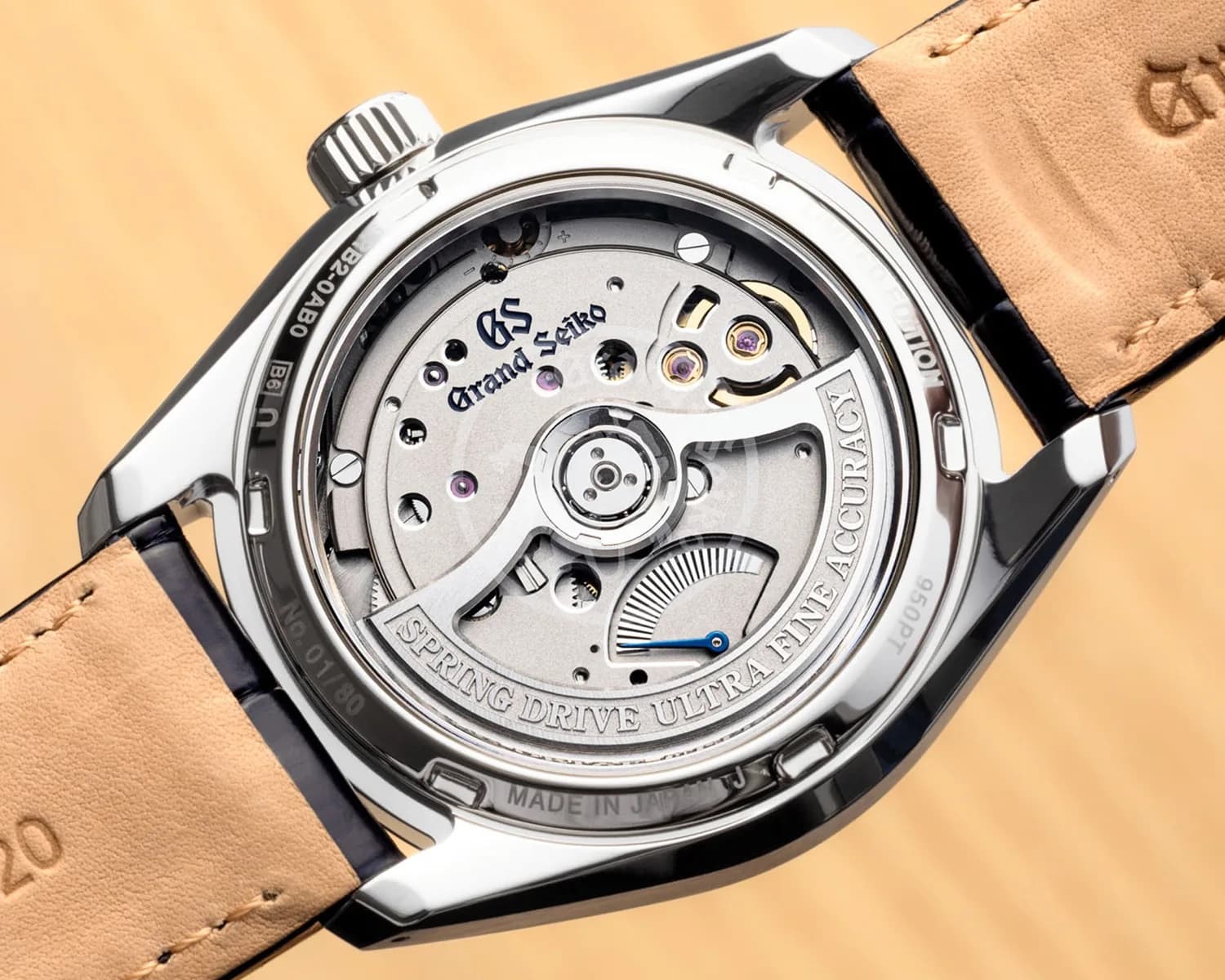
A third kind of watch
Most watch lovers learn early that there are two families of movements: mechanical ones with a mainspring and an escapement, and quartz ones with a battery and a vibrating crystal. Spring Drive refuses to sit in either camp. It is powered by a mainspring, like a classic automatic, yet its timekeeping is governed by quartz.
Seiko calls it the third engine of the industry. There is no battery, primary or secondary, and no step motor. The seconds hand does not tick and does not stutter. It glides.
What replaces the escapement
In a conventional mechanical watch, the lever escapement chops the mainspring’s energy into small, regular steps.
Spring Drive removes the escapement altogether. In its place sits a glide wheel, regulated by a quartz oscillator, an integrated circuit and electromagnets. The whole assembly is called the Tri-synchro regulator, and its motion is one-way, which makes it more stable and precise than a back-and-forth escapement.
The mainspring still supplies the force. The regulator decides how quickly that force is spent.
How the glide wheel keeps time
The quartz crystal inside vibrates 32,768 times per second. A frequency divider reduces that to an 8 Hz reference signal, and that signal is the beat the glide wheel is asked to follow. The wheel is meant to turn eight times each second.
As the wheel spins, it generates a small amount of electricity through a stator coil. That is what powers the circuit, which is why no battery is needed.
When the wheel runs too fast, the integrated circuit applies an electromagnetic brake, slowing it back to pace. The result is a seconds hand that sweeps smoothly around the dial, with accuracy within ±15 seconds per month.
An engineer’s long dream
The idea belongs to Yoshikazu Akahane, an engineer at Suwa Seikosha. In 1977 his dream was a watch that would last forever and stay within one second a day. He had already worked out the Twin quartz principle before turning to this problem.
A patent application followed in 1978. Along the way the Kinetic caliber, launched in 1988, helped move the project forward. Takahashi joined the team in 1993 and designed the mechanism that gives the seconds hand its smooth sweep.
A prototype integrated circuit was first put into a watch on December 26, 1997. More than 600 prototypes were made between the patent and the 1998 announcement.
The movement was shown at the 1998 Basel Watch Fair.
From first release to automatic
Spring Drive reached customers in 1999, first in Japan, as limited edition manual-wind watches. The first movement was caliber 7R68, and Seiko launched it as the world’s first watch to combine mainspring power with quartz control.
The first automatic-winding Spring Drive model came in 2005.
Longer reserves, finer accuracy
Spring Drive Chronograph has a power reserve of 72 hours, even with the chronograph running without a pause. Its second hand can measure up to twelve hours and stops exactly when the button is pressed, and the watch keeps ±15 seconds per month while it runs.
Caliber 9RA, released in 2020, brought a reserve of about five days by using barrels of two different sizes. Grand Seiko rates its Spring Drive at ±1 second per day, which is tighter than COSC standards.
More recently, the Spring Drive U.F.A. was announced in 2025, accurate to ±20 seconds per year. Its calibers, the 9RB1 with 33 jewels and the 9RB2 with 34 jewels, carry the idea forward.
Where it is found
Spring Drive is made by Epson in Shiojiri, and it appears in Seiko Watch Corporation brands including Credor, Grand Seiko, Presage and Prospex. Grand Seiko even grows its own quartz crystals for it and for its high-accuracy quartz watches.
The Seiko Spacewalk is a limited edition Spring Drive model designed for use in space.